[a medicinal cooking blog: using food as medicine to treat whatever may ail you]
Showing posts with label the spice doc. Show all posts
Thursday, April 12, 2012
A Few Nibbles and a Bit of News
The reason I have been missing in action on here is I have thrown myself into the last few months of work for the launch of the new and improved Spice Doc site. It will still live at www.thespicedoc.com but not too long from now you will be directed to a fresh new site, with lots of exciting functions that will be unveiled when it's up. Who knew it could take so much love and work to build one of these? I have had my phenomenal friend, artist, and designer, Patricia Callison, imagining away at this for over a year now. If you want to see her incredible work go to Made in Mind. And about 6 months or so ago, Conor Browne, the Spice Doc programmer, joined and has been making Trish's beautiful ideas come to life with his own brilliance. In the meantime I chip away at the content little by little.
While I've been doing that, I've also been cooking up a (medicinal) storm with all kinds of herbs and ingredients, studying Mandarin 4 hours+++ every day, and have begun to translate medicinal cook book recipes into English. A few chefs have opened their doors for me to show me one on one their secret medicinal recipes. And many more people have shared what they've learned from their grandmothers, mothers, fathers, aunts, uncles, doctors, etc. in terms of the strongly ingrained culture of medicinal cooking here in China. Every day I'm learning something new. There's not much more you can ask for! I can't wait to share that with everyone, TCM practitioners and laymen alike.
See you very soon!
Thursday, April 5, 2012
The Three S's : Soups, Salad, and Spring
(recycled from 4/11/2010)

Now that Spring is arriving, it's time to lighten the food load a bit, and increase your fresh vegetable and fruit intake. However, it is still incredibly important to avoid going all raw and salad-crazy just because the weather is warmer. Your digestion is still like a furnace, even in the summer months, and works at it's optimum when you treat it kindly with warm foods. If you begin to plow yourself with one salad after another, many of you will find yourselves in the grips of gas, bloating, loose stools, phlegm attacks, sluggishness, or wrap around headaches.

A great way to protect your digestion but also crunch away on a crispy light salad, is to make a warm light soup to have before, or with, your salad. I prefer to keep the soups lighter and vegetable-based and I add a warm piece of cooked protein (such as fish or chicken) to the salad to add another warm element. Spring is a time for renewal and cleansing and evolving with the seasons makes sense for your health. Many people ask me about doing detoxes during this time, I don't personally recommend heavy detoxing if you are still living your life as usual, working, running around, and stressing, so I often recommend an "eating fast" which you can find information about here.

Below you will find the recipe for a vegetable, vitamin, and mineral rich soup (Spinach, Roasted Red Pepper, and Yogurt Soup) to pair with whatever your favorite salad might be. Spinach is cooling in thermal nature, with a sweet flavor. It is a wonderful vegetable for moistening and nourishing the body, especially in conditions that create thirst and dryness (such as diabetes) and also at the end of a long drying winter. Spinach can also treat constipation and urinary difficulty and is of course known for being high in vitamin A and calcium. Red peppers are excellent in treating stagnant digestion (often the case at the end of a winter full of cloying heavy foods), as well as being high in vitamin C, and increasing circulation. Plain yogurt adds good dairy as well as some probiotic action. Roasting the red peppers adds more energy to the food (or yang energy as it is referred to in Chinese Medicine), while still maintaining the moistening and yin quality of the food.

Spinach, Roasted Red Pepper, and Yogurt Soup
Ingredients: 1 bunch of spinach, 2 red peppers, chicken or vegetable stock, 1 sweet white onion, plain yogurt, extra virgin olive oil, salt and pepper
1. Roast red peppers either over a low flame or under a broiler. Wash and place on a baking pan and make sure to turn each side as it blackens. Remove from oven and rinse under cool water, peel off outer layer of skin and slice into thin slices.
2. Chop up one whole onion and saute in extra virgin olive oil on a low heat until they begin to caramelize, add rinsed spinach and stir until it begins to soften.
3. Add 2-3 cups chicken or vegetable stock plus 1-2 cups of water (depending on how thick you want the soup), add salt and pepper to taste. Add roasated red peppers and let it sit on a slow boil for a few minutes so everything melds together.
4. Add one cup of yogurt and mix in. Remove soup from heat and let it cool. Blend into a thick consistency and reheat before serving. You can add an extra dollop of yogurt and minced cilantro and crunch sea salt on top before serving or just serve as is.
Enjoy!
Now that Spring is arriving, it's time to lighten the food load a bit, and increase your fresh vegetable and fruit intake. However, it is still incredibly important to avoid going all raw and salad-crazy just because the weather is warmer. Your digestion is still like a furnace, even in the summer months, and works at it's optimum when you treat it kindly with warm foods. If you begin to plow yourself with one salad after another, many of you will find yourselves in the grips of gas, bloating, loose stools, phlegm attacks, sluggishness, or wrap around headaches.
A great way to protect your digestion but also crunch away on a crispy light salad, is to make a warm light soup to have before, or with, your salad. I prefer to keep the soups lighter and vegetable-based and I add a warm piece of cooked protein (such as fish or chicken) to the salad to add another warm element. Spring is a time for renewal and cleansing and evolving with the seasons makes sense for your health. Many people ask me about doing detoxes during this time, I don't personally recommend heavy detoxing if you are still living your life as usual, working, running around, and stressing, so I often recommend an "eating fast" which you can find information about here.
Below you will find the recipe for a vegetable, vitamin, and mineral rich soup (Spinach, Roasted Red Pepper, and Yogurt Soup) to pair with whatever your favorite salad might be. Spinach is cooling in thermal nature, with a sweet flavor. It is a wonderful vegetable for moistening and nourishing the body, especially in conditions that create thirst and dryness (such as diabetes) and also at the end of a long drying winter. Spinach can also treat constipation and urinary difficulty and is of course known for being high in vitamin A and calcium. Red peppers are excellent in treating stagnant digestion (often the case at the end of a winter full of cloying heavy foods), as well as being high in vitamin C, and increasing circulation. Plain yogurt adds good dairy as well as some probiotic action. Roasting the red peppers adds more energy to the food (or yang energy as it is referred to in Chinese Medicine), while still maintaining the moistening and yin quality of the food.
Spinach, Roasted Red Pepper, and Yogurt Soup
Ingredients: 1 bunch of spinach, 2 red peppers, chicken or vegetable stock, 1 sweet white onion, plain yogurt, extra virgin olive oil, salt and pepper
1. Roast red peppers either over a low flame or under a broiler. Wash and place on a baking pan and make sure to turn each side as it blackens. Remove from oven and rinse under cool water, peel off outer layer of skin and slice into thin slices.
2. Chop up one whole onion and saute in extra virgin olive oil on a low heat until they begin to caramelize, add rinsed spinach and stir until it begins to soften.
3. Add 2-3 cups chicken or vegetable stock plus 1-2 cups of water (depending on how thick you want the soup), add salt and pepper to taste. Add roasated red peppers and let it sit on a slow boil for a few minutes so everything melds together.
4. Add one cup of yogurt and mix in. Remove soup from heat and let it cool. Blend into a thick consistency and reheat before serving. You can add an extra dollop of yogurt and minced cilantro and crunch sea salt on top before serving or just serve as is.
Enjoy!
Wednesday, February 29, 2012
Butternut Squash Soup with a Hint of Spice
(recycled from 1/5/2011)

Yellow and sweet. The color and taste which treat the digestive system in Chinese Medicine. If you're feeling anything like I am at the moment, your digestive system could use a little tender loving care after the whirlwind that is November through December with Thanksgiving followed by one Christmas party after another. Instead of making daunting New Year's resolutions by starving yourself, this soup will soothe you and your stomach without breaking the scale further.

Right now root vegetables, gourds, and tubers are in season. And, eating in season is the best way to truly eat medicinally. Butternut squash tastes precisely as it has been rightly named. Buttery (without butter), sweet, and meaty in it's own right. This soup takes no longer than 30 minutes to make and you can freeze batches of it if you plan to reheat whenever you need a little more tender loving care for your stomach, which is precisely what the Year of the Rabbit (coming up on February 3) is all about, gentle and soothing after the fire of the Year of the Tiger.

Ingredients: 1 medium or large butternut squash, 1 white onion, 1 garlic clove, 1 leek, 1 tbspn tomato paste, salt, pepper, curry powder (or use a combination of cumin, tumeric, dried chile), 1 tsp fresh ground ginger, cilantro, plain yogurt (my preference is Greek yogurt), chicken or vegetable stock, 1 bay leaf

Directions:
1. Peel squash and slice through the center, de-seed (you can keep them to toast and eat if you wish). Chop into large squares.
2. Slice onion into moon slices, wash and slice whole leek, mince 1 garlic clove, mince up 1 tsp of ginger, have all other spices and ingredients on hand.
3. Saute onion, leek, and squash until they both get a little soft and have color (about 5+ minutes), add minced garlic, 1 bay leaf, 1 tbspn tomato paste, 1 tbspn curry powder or aforementioned combination of spices (you can add this to taste), keep cooking all together until it's well mixed then add 2 cups of chicken or vegetable stock.
4. Bring to a boil and cook for 10-15 minutes until the squash is soft, add 1 cup of plain yogurt (if you wish to have a thicker creamier soup, add 1 cup of coconut milk instead). Boil together another 5 minutes, pull out bay leaves and then let the soup cool for a few minutes before blending together (either with an immersion blender or in a regular blender, in which case you would need it to be at room temperature).
5. Reheat and serve with a garnish of cilantro if you wish and a sprinkle of crunchy sea salt.
Yellow and sweet. The color and taste which treat the digestive system in Chinese Medicine. If you're feeling anything like I am at the moment, your digestive system could use a little tender loving care after the whirlwind that is November through December with Thanksgiving followed by one Christmas party after another. Instead of making daunting New Year's resolutions by starving yourself, this soup will soothe you and your stomach without breaking the scale further.
Right now root vegetables, gourds, and tubers are in season. And, eating in season is the best way to truly eat medicinally. Butternut squash tastes precisely as it has been rightly named. Buttery (without butter), sweet, and meaty in it's own right. This soup takes no longer than 30 minutes to make and you can freeze batches of it if you plan to reheat whenever you need a little more tender loving care for your stomach, which is precisely what the Year of the Rabbit (coming up on February 3) is all about, gentle and soothing after the fire of the Year of the Tiger.
Ingredients: 1 medium or large butternut squash, 1 white onion, 1 garlic clove, 1 leek, 1 tbspn tomato paste, salt, pepper, curry powder (or use a combination of cumin, tumeric, dried chile), 1 tsp fresh ground ginger, cilantro, plain yogurt (my preference is Greek yogurt), chicken or vegetable stock, 1 bay leaf
Directions:
1. Peel squash and slice through the center, de-seed (you can keep them to toast and eat if you wish). Chop into large squares.
2. Slice onion into moon slices, wash and slice whole leek, mince 1 garlic clove, mince up 1 tsp of ginger, have all other spices and ingredients on hand.
3. Saute onion, leek, and squash until they both get a little soft and have color (about 5+ minutes), add minced garlic, 1 bay leaf, 1 tbspn tomato paste, 1 tbspn curry powder or aforementioned combination of spices (you can add this to taste), keep cooking all together until it's well mixed then add 2 cups of chicken or vegetable stock.
4. Bring to a boil and cook for 10-15 minutes until the squash is soft, add 1 cup of plain yogurt (if you wish to have a thicker creamier soup, add 1 cup of coconut milk instead). Boil together another 5 minutes, pull out bay leaves and then let the soup cool for a few minutes before blending together (either with an immersion blender or in a regular blender, in which case you would need it to be at room temperature).
5. Reheat and serve with a garnish of cilantro if you wish and a sprinkle of crunchy sea salt.
Thursday, January 19, 2012
Winter Hash
(recycled from 12/17/2010)

If you live anywhere near where I do and are beginning to feel the effects of the wind, cold, dryness, and lack of sun, then you are likely in need of something warm, nourishing, and colorful on your plate! Immediately. There is never a more significant time than now in the midst of this chilling season to begin paying attention to getting all those colors on your plate. You simply aren't going to get enough vitamins and minerals if you work in an office, come home when it's dark already at 4 p.m., and to top it off when you are outside the only bits of you the world can see is your eyes and nose (therefore the sun isn't going to bless you with it's nutrients)!
In Chinese Medicine, eating with the seasons as well as eating the colors and tastes of the five elements is essential to balanced health. Given that it is winter, you want to eat warm to counteract the effects of the cold. Winter is also a time when your kidneys and lungs are more susceptible to damage and illness and can manifest in symptoms such as : cold hands and feet, arthritis, painful joints, lower back pain, dry cough, colds, flu's, skin dryness, and general malaise. If you go by the five element chart (which I discussed here) the lungs pertain to the color white and the spicy flavor, and the kidneys pertain to the color black and the salty taste. While these particular organs are more susceptible in the winter, you shouldn't neglect the other major organ systems in Chinese Medicine : the liver (green & sour), the digestive function (yellow & sweet), and the heart (red & bitter). If you are wondering what it means for an organ to pertain to a taste and a color (and if you haven't gone here already), this is part of the Traditional Chinese Medicine nutritional theory whereby you treat certain organs and systems with specifically colored foods and tastes. A daikon radish is a perfect example of a white and spicy food which can benefit the lungs. Sometimes you won't find one food that satisfies both the color and taste of an organ system, in which case you might combine a color with a taste (perhaps a white radish with a sprinkle of chile flakes to open up the lungs).

A very simple way to make sure you're getting all the healthful benefits of vitamins, minerals, colors, and tastes is to make sure you eat a variety of (naturally occurring) colors every day. This winter hash is a perfect example of this. You can eat it as a side dish, you can use it to stuff something (a chicken or turkey perhaps? or a mushroom as I did recently), you can have it with eggs, and you can also just eat it alone. You can absolutely stray from this version of the recipe if you don't like carrots and prefer parsnips, or something along those lines.

In this particular Winter Hash, I used onions, leeks, carrots, yellow potatoes, sea salt, black pepper, cumin, and chile flakes. I cooked it all low and slow until it comes together into this beautiful melded hash that is both sweet and salty with a lovely spice along the edeges.

Ingredients Needed (winter vegetables preferable) : 1 onion, 1-2 leeks, 3 small yellow potatoes, 4 carrots, cumin, chile (fresh or flaked), sea salt, black pepper.

1. Slice up onions and leeks (leeks may need extra rinsing as they carry a lot of dirt). Begin to saute them slowly in olive oil until they just begin to cook.
2. Peel and cut up carrots and potatoes (parsnips or turnips would be great here too). Add to pan and turn up heat ever so slightly so it all begins to sear a bit, then turn it low again.

3. Add 1 tsp of cumin, a sprinkle of chile flakes (or more if you want more kick), salt and black pepper to taste.
4. Cook on low heat for about 30 mins to 1 hour (depends on how much you are cooking). At the very end turn up the heat once again for a few minutes to give it more caramelizing and color without burning.

(If you mince up the ingredients very finely you can use them to stuff mushrooms with, put a slice of pecorino on top and bake at 400 degrees F for 10-15 minutes.)
If you live anywhere near where I do and are beginning to feel the effects of the wind, cold, dryness, and lack of sun, then you are likely in need of something warm, nourishing, and colorful on your plate! Immediately. There is never a more significant time than now in the midst of this chilling season to begin paying attention to getting all those colors on your plate. You simply aren't going to get enough vitamins and minerals if you work in an office, come home when it's dark already at 4 p.m., and to top it off when you are outside the only bits of you the world can see is your eyes and nose (therefore the sun isn't going to bless you with it's nutrients)!
In Chinese Medicine, eating with the seasons as well as eating the colors and tastes of the five elements is essential to balanced health. Given that it is winter, you want to eat warm to counteract the effects of the cold. Winter is also a time when your kidneys and lungs are more susceptible to damage and illness and can manifest in symptoms such as : cold hands and feet, arthritis, painful joints, lower back pain, dry cough, colds, flu's, skin dryness, and general malaise. If you go by the five element chart (which I discussed here) the lungs pertain to the color white and the spicy flavor, and the kidneys pertain to the color black and the salty taste. While these particular organs are more susceptible in the winter, you shouldn't neglect the other major organ systems in Chinese Medicine : the liver (green & sour), the digestive function (yellow & sweet), and the heart (red & bitter). If you are wondering what it means for an organ to pertain to a taste and a color (and if you haven't gone here already), this is part of the Traditional Chinese Medicine nutritional theory whereby you treat certain organs and systems with specifically colored foods and tastes. A daikon radish is a perfect example of a white and spicy food which can benefit the lungs. Sometimes you won't find one food that satisfies both the color and taste of an organ system, in which case you might combine a color with a taste (perhaps a white radish with a sprinkle of chile flakes to open up the lungs).
A very simple way to make sure you're getting all the healthful benefits of vitamins, minerals, colors, and tastes is to make sure you eat a variety of (naturally occurring) colors every day. This winter hash is a perfect example of this. You can eat it as a side dish, you can use it to stuff something (a chicken or turkey perhaps? or a mushroom as I did recently), you can have it with eggs, and you can also just eat it alone. You can absolutely stray from this version of the recipe if you don't like carrots and prefer parsnips, or something along those lines.
In this particular Winter Hash, I used onions, leeks, carrots, yellow potatoes, sea salt, black pepper, cumin, and chile flakes. I cooked it all low and slow until it comes together into this beautiful melded hash that is both sweet and salty with a lovely spice along the edeges.
Ingredients Needed (winter vegetables preferable) : 1 onion, 1-2 leeks, 3 small yellow potatoes, 4 carrots, cumin, chile (fresh or flaked), sea salt, black pepper.
1. Slice up onions and leeks (leeks may need extra rinsing as they carry a lot of dirt). Begin to saute them slowly in olive oil until they just begin to cook.
2. Peel and cut up carrots and potatoes (parsnips or turnips would be great here too). Add to pan and turn up heat ever so slightly so it all begins to sear a bit, then turn it low again.
3. Add 1 tsp of cumin, a sprinkle of chile flakes (or more if you want more kick), salt and black pepper to taste.
4. Cook on low heat for about 30 mins to 1 hour (depends on how much you are cooking). At the very end turn up the heat once again for a few minutes to give it more caramelizing and color without burning.
(If you mince up the ingredients very finely you can use them to stuff mushrooms with, put a slice of pecorino on top and bake at 400 degrees F for 10-15 minutes.)
Tuesday, December 6, 2011
Kitchen Medicine
I'm going to be missing in action for a little while here. I have to pool all my resources and energy into finishing a big project, soon to be unveiled, and it requires all my attention.
Before I leave (and I will return before you know it), I wanted to share some recent colors in the market. As well as some old and new medicinal cooking tricks. There's so much to digest (literally and figuratively) since my move to Chongqing as per the medicinal cooking that there isn't enough room on here to share it all!
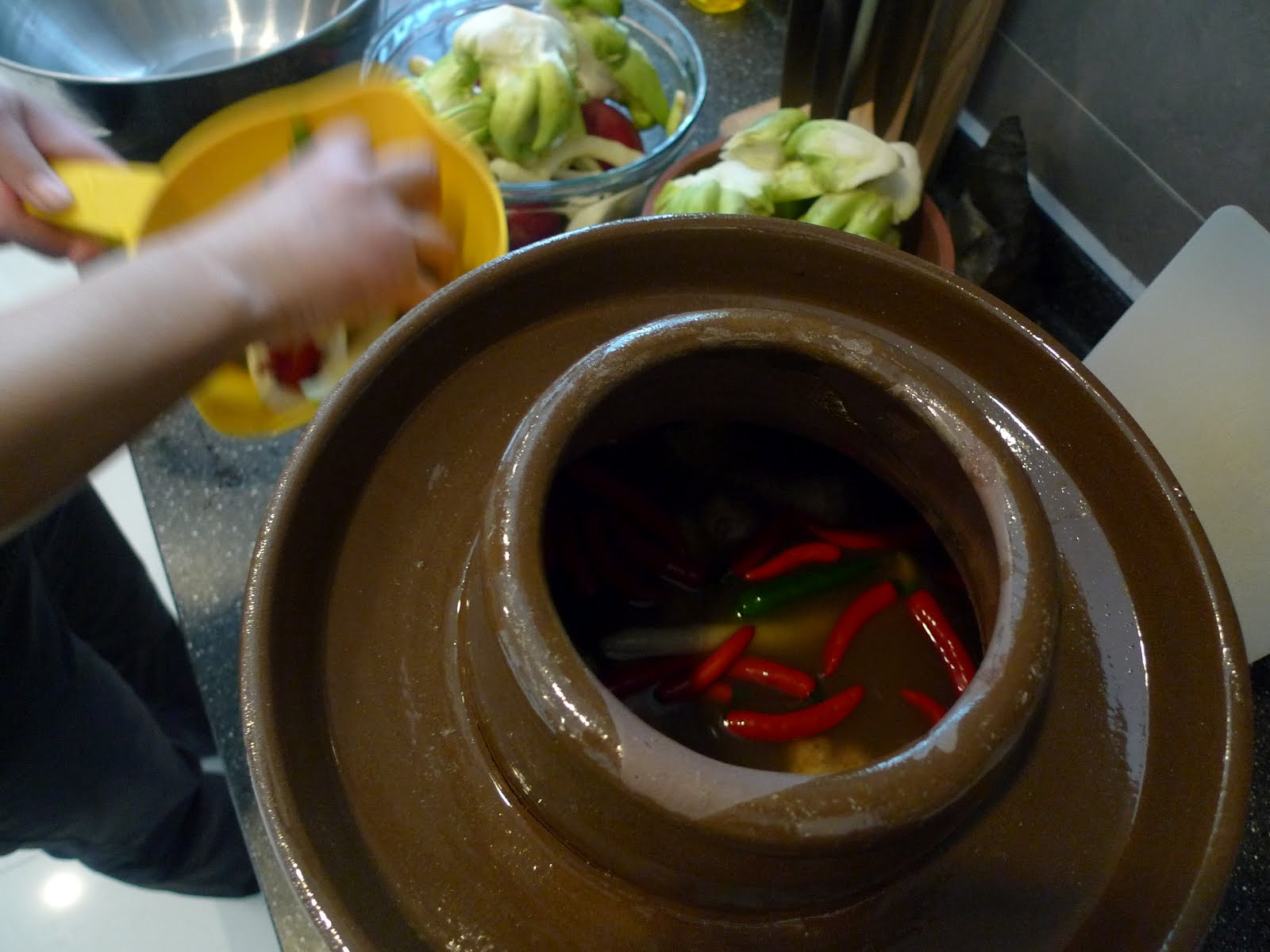
For those that aren't TCM practitioners and reading this, if you don't know about the five elements and how that correlates to medicinal cooking as per TCM (Traditional Chinese Medicine) then it's important for me to briefly lay it out as it's the building blocks upon which the cooking begins. I discussed it in a post a few months ago here. Above is a picture of foods and their correlates, and below is a list of the basics. At first glance it's so simple and beautiful, and then you begin to realize that it gets all intertwined and a bit wild like a creeping banyan tree's roots which climb all over each other. For example, you might wonder if red and bitter treat the heart and small intestine, then a red chile would make sense? It's red and bitter. But it's also spicy, which falls into the category of the lung and large intestine. Don't over think it too much. As a layman you don't need to decipher it to that degree. If you're designing a treatment plan for a patient with a serious chronic (or acute) illness, you will of course need to be more fastidious with the plan. However, if you are just simply eating in a normal way, to be healthy, to be preventative, and to enjoy your food while you have a go at it, then just think this simply : colors and flavors correlate to particular organ systems.
Black & Salty = Kidneys & Urinary Bladder
Red & Bitter = Heart & Small Intestine
White & Spicy = Lung & Large Intestine
Yellow & Sweet = Digestive System (Stomach & Spleen)
Green & Sour = Liver & Gallbladder
You will do no harm by thinking in this way and you will definitely hit all your target vitamin, mineral, and all that other jazz that they like to throw out at you in today's nutritional requirements dialogue. Sometimes you wonder, how did we survive before when we weren't measuring out calories, B12, saturated fat, unsaturated fat, carbohydrates, sodium levels, vitamin D, etc. etc. etc. There is a time and a place for that, of course, and that's mostly in the classroom not in the kitchen. It's confusing and makes you, me, all of us riddled with a subterranean angst wherein more often than not, you miss the point of the whole thing. Interestingly enough, every week an article will pop up expounding on a new study with the news flash that (something you could have derived from the chart above) actually does good for one of the organs linked to the flavor and color.
The next level of TCM medicinal cooking theory is that everything is broken down into warm, hot, cool, or cold. This too gets a little confusing. Or coRnfusing as a friend loves to say. You might initially only think in terms of a hot soup versus a cold cucumber, and while this is true in terms of being warming (soup) and being cooling (cucumber), you might not think of how some meat's are hot (beef), some are warming (chicken), and some are cooling (crab), though you can eat all of them warm. There is the thermal nature of a food (cool/cold/warm/hot) which is what I am referring to here, and then there is the way you eat it (cold or warm). Suffice it to say, it's a lot to memorize and in the case of cool/cold/warm/hot, the best way to approach this (unless you want to dive into the academics of it) is to know your constitution and then be conscious of how you eat according to that. If you tend to run really hot, and have a red flushed face more often than not, then avoid heat-inducing foods that might exacerbate your condition. If you run cold, and are weak and lethargic with loose stools, don't go on a raw cucumber binge. Having said that, I will mention that in TCM you do rely on the general premise that eating warm foods (as in the temperature - such as a soup, not necessarily the thermal nature as in beef or chiles which are hot) is important for good digestion.
I learned a new thermal tidbit last week, which is common layman's knowledge here in China. Oranges are cooling and tangerines are hot. The interesting thing is that people know this here, and they abide by it. If they run hot, they don't go wild for clementines (considered to be in the tangerine category) in this season. If you have insomnia or red inflamed acne, you might want to watch out too!
And lastly, a cooking tip I learned as per fresh water fish (any non ocean fish) : take your fish, do what you need to do it (keep it whole and gutted or filleted) and submerge it in water with vinegar (not too much, a tablespoon for a medium size fish will suffice) for 24 hours in order to cleanse the blood of the fish, sweeten it's flavor, and help it to hold it's integrity in the cooking process. If you're on my facebook page, you've heard about this tip twice already, so apologies for the repetition!
And with that, I will be crawling into my office to peck away at the final stages of my project. If I don't get here before the holiday madness, remember to drink something bitter after a meal to help you to digest all the goodies you'll be partaking in and see you in 2012!
Thursday, March 31, 2011
Burn Salve : Egg Whites
Hot off the press (though it's been around the block and back for some time) : egg whites are an excellent salve for burns. The high collagen content helps in healing and soothing the burn as well as restoring the skin to it's natural condition. You want to keep applying layers of egg white as they dry and form a white film over the burn area. If you have a third degree burn this absolutely does not apply, but in the case of a moderate sunburn (for example) that is still in the first degree category this might just be the remedy you were looking for. Do not apply when there are blisters on the skin, this is best used after the acute stages. If the burn is either larger than your palm or has penetrated past the dermis layer of skin, consult a doctor immediately. Part of the reason egg whites are so healing is that it is basically the placenta of the developing chicken and placenta has always had a long history as a healing medicinal, in both TCM and Native American medicine. Some other home remedies that have been recommended for burns are : aloe vera, honey, and vinegar.
Wednesday, January 5, 2011
(Happy 2011!) Butternut Squash Soup with a Hint of Spice
Yellow and sweet. The color and taste which treat the digestive system in Chinese Medicine. If you're feeling anything like I am at the moment, your digestive system could use a little tender loving care after the whirlwind that is November through December with Thanksgiving followed by one Christmas party after another. Instead of making daunting New Year's resolutions by starving yourself, this soup will soothe you and your stomach without breaking the scale further.
Right now root vegetables, gourds, and tubers are in season. And, eating in season is the best way to truly eat medicinally. Butternut squash tastes precisely as it has been rightly named. Buttery (without butter), sweet, and meaty in it's own right. This soup takes no longer than 30 minutes to make and you can freeze batches of it if you plan to reheat whenever you need a little more tender loving care for your stomach, which is precisely what the Year of the Rabbit (coming up on February 3) is all about, gentle and soothing after the fire of the Year of the Tiger.
Ingredients: 1 medium or large butternut squash, 1 white onion, 1 garlic clove, 1 leek, 1 tbspn tomato paste, salt, pepper, curry powder (or use a combination of cumin, tumeric, dried chile), 1 tsp fresh ground ginger, cilantro, plain yogurt (my preference is Greek yogurt), chicken or vegetable stock, 1 bay leaf
Directions:
1. Peel squash and slice through the center, de-seed (you can keep them to toast and eat if you wish). Chop into large squares.
2. Slice onion into moon slices, wash and slice whole leek, mince 1 garlic clove, mince up 1 tsp of ginger, have all other spices and ingredients on hand.
3. Saute onion, leek, and squash until they both get a little soft and have color (about 5+ minutes), add minced garlic, 1 bay leaf, 1 tbspn tomato paste, 1 tbspn curry powder or aforementioned combination of spices (you can add this to taste), keep cooking all together until it's well mixed then add 2 cups of chicken or vegetable stock.
4. Bring to a boil and cook for 10-15 minutes until the squash is soft, add 1 cup of plain yogurt (if you wish to have a thicker creamier soup, add 1 cup of coconut milk instead). Boil together another 5 minutes, pull out bay leaves and then let the soup cool for a few minutes before blending together (either with an immersion blender or in a regular blender, in which case you would need it to be at room temperature).
5. Reheat and serve with a garnish of cilantro if you wish and a sprinkle of crunchy sea salt.
Friday, December 17, 2010
Winter Hash
If you live anywhere near where I do and are beginning to feel the effects of the wind, cold, dryness, and lack of sun, then you are likely in need of something warm, nourishing, and colorful on your plate! Immediately. There is never a more significant time than now in the midst of this chilling season to begin paying attention to getting all those colors on your plate. You simply aren't going to get enough vitamins and minerals if you work in an office, come home when it's dark already at 4 p.m., and to top it off when you are outside the only bits of you the world can see is your eyes and nose (therefore the sun isn't going to bless you with it's nutrients)!
In Chinese Medicine, eating with the seasons as well as eating the colors and tastes of the five elements is essential to balanced health. Given that it is winter, you want to eat warm to counteract the effects of the cold. Winter is also a time when your kidneys and lungs are more susceptible to damage and illness and can manifest in symptoms such as : cold hands and feet, arthritis, painful joints, lower back pain, dry cough, colds, flu's, skin dryness, and general malaise. If you go by the five element chart (which I discussed here) the lungs pertain to the color white and the spicy flavor, and the kidneys pertain to the color black and the salty taste. While these particular organs are more susceptible in the winter, you shouldn't neglect the other major organ systems in Chinese Medicine : the liver (green & sour), the digestive function (yellow & sweet), and the heart (red & bitter). If you are wondering what it means for an organ to pertain to a taste and a color (and if you haven't gone here already), this is part of the Traditional Chinese Medicine nutritional theory whereby you treat certain organs and systems with specifically colored foods and tastes. A daikon radish is a perfect example of a white and spicy food which can benefit the lungs. Sometimes you won't find one food that satisfies both the color and taste of an organ system, in which case you might combine a color with a taste (perhaps a white radish with a sprinkle of chile flakes to open up the lungs).
A very simple way to make sure you're getting all the healthful benefits of vitamins, minerals, colors, and tastes is to make sure you eat a variety of (naturally occurring) colors every day. This winter hash is a perfect example of this. You can eat it as a side dish, you can use it to stuff something (a chicken or turkey perhaps? or a mushroom as I did recently), you can have it with eggs, and you can also just eat it alone. You can absolutely stray from this version of the recipe if you don't like carrots and prefer parsnips, or something along those lines.
In this particular Winter Hash, I used onions, leeks, carrots, yellow potatoes, sea salt, black pepper, cumin, and chile flakes. I cooked it all low and slow until it comes together into this beautiful melded hash that is both sweet and salty with a lovely spice along the edeges.
Ingredients Needed (winter vegetables preferable) : 1 onion, 1-2 leeks, 3 small yellow potatoes, 4 carrots, cumin, chile (fresh or flaked), sea salt, black pepper.
1. Slice up onions and leeks (leeks may need extra rinsing as they carry a lot of dirt). Begin to saute them slowly in olive oil until they just begin to cook.
2. Peel and cut up carrots and potatoes (parsnips or turnips would be great here too). Add to pan and turn up heat ever so slightly so it all begins to sear a bit, then turn it low again.
3. Add 1 tsp of cumin, a sprinkle of chile flakes (or more if you want more kick), salt and black pepper to taste.
4. Cook on low heat for about 30 mins to 1 hour (depends on how much you are cooking). At the very end turn up the heat once again for a few minutes to give it more caramelizing and color without burning.
(If you mince up the ingredients very finely you can use them to stuff mushrooms with, put a slice of pecorino on top and bake at 400 degrees F for 10-15 minutes.)
Friday, November 12, 2010
Travelling Medicine: Brittany and Normandy
November and December seem to always zip by so quickly, it's like the last burst of speed to the finish line, and then poof! There goes 2010. But we still have some time...and in that time, I've been to Brittany and Normandy (as well as Turin, Italy, but I'll save that for later). It was cool and breezy, with picturesque greys and greens. Everything was still lush from the rain, the oysters were out of control delicious and briny, the cows producing spectacularly silky dairy products for the richness that is the Breton and Norman cuisine, figs were oozing sweetness out of their purplish brown skins begging for a pungent aged camembert, and the walnut and chestnut tree's were half way through dropping their fruit for us to enjoy. I stocked up on sea salt in all it's shapes and forms along the way, and lugged it back in a borderline too heavy suitcase with an exasperated husband.
This trip was particularly tasty and it was hard to narrow it down, so I've focused on the seasonal and medicinal delights that we encountered along the way.
The first treat we got to nibble away at were tender, sweet, purple figs. Figs travelled a long way to get to France, as they were likely first cultivated 6,000 years ago in Asia Minor before reaching the Mediterranean. There are two seasons for figs in France, late summer and mid Fall to around November. From the perspective of Chinese Medicine, purple figs are excellent blood and digestive tonics given that they are sweet and reddish in color. In addition, their multitudinous miniature seeds which you ingest upon taking a bite of this fruit, are extremely effective in the treatment of constipation. In Chinese Medicine theory, seeds and nuts are used to help lubricate and move the bowels. Sexy stuff! For those that squirm when I mention your digestive regularity, fear not, figs are well worth it when in season, regardless of your intentions.
(oysters vendors by the piers in Cancale)
Cancale, France is possibly one of my favorite places on earth. Allow your eyes to glaze over and see past the touristy bits of this quaint seaside fishing village, they have some of the BEST oysters I have happily slurped down in my life. That's saying a lot given that I would eat oysters for breakfast, lunch, and dinner in my dream life. They tasted like a trip across the ocean with the salty water and sun splashing on your face. Much like when you put a big shell to your ear to hear the roar of the ocean, these oysters tasted pure like that sound. And in Chinese Medicine they fall into the category of kidney tonics given their salty taste and briny beginnings. In France, oysters are being gobbled up in the November and December months and they are a common staple at the Christmas table. In popular (and ancient) culture, oysters have always been given aphrodisiac status, which falls in line with the kidney tonic theory that Chinese Medicine lends them as the kidneys are key in matters of fertility.
(walnut tree)
(fallen walnut)
(chestnut tree)
(saved chesnut)
Oysters aren't the only kidney tonics, walnuts and chestnuts also fall in line with this medicinal value. We were lucky enough to have access to a walnut tree in a family members back yard and a chestnut tree at a manor where we attended a wedding. Walnuts are particularly beneficial to the kidney yang aspect of the body, meaning : chronic cough with wheezing, infertility, chronic lower back pain and weakness, and impotence. Walnuts are thermally warming, have a sweet flavor, and reduce inflammation as well as eliminate pain (Healing With Whole Foods, P. Pitchford). Chesnuts, another lovely winter nut found in abundance during this time of year treat the kidney, stomach, and spleen, giving them the additional benefit of being digestive tonics on top of their kidney benefits.
Ahhh, the lovely cows everywhere we drove through Brittany and Normandy! They were all standing about chewing away peacefully until I would force whoever was driving to stop so I could take the millionth picture of another cow and it would inevitably turn around and face me, stop chewing, and wonder why I had to disturb it (much like in the picture above). Bovine dairy is a bit controversial at times, due mainly to poor breeding and production practices, but it also has it's place medicinally when you can access healthy dairy like the dairy found in Brittany and Normandy where the cows are out to pasture and aren't fed bovine growth hormone or antibiotics (primarily because they are out to pasture and there is no rush). From the perspective of Chinese Medicine, milk has building and strengthening properties so long as you are not suffering from any of the following (in which case, use in moderation or not at all): sinus congestion, chronic skin issues, obesity, or phlegm. If you want to know more about milk, see here for a previous post on it. In Brittany and Normandy, it was hard to resist the excellent butter, delicious milk, and not to mention the phenomenal cheeses (Camembert, Pays d' Auge, and the variety of chevres) everywhere we went. Many meals ended with a slice of fragrant cheese and prepared our stomachs for the onslaught of Thanksgiving feasting that was around the corner!
(whatcha lookin' at?)
Wednesday, August 4, 2010
Crazy About Carrots
Carrots are a surprising vegetable. How surprising can they really be you might wonder when we have all heard how carrots are good for your eyesight and many of us have that image of a cartoon bunny chomping away on a carrot just like popeye slurped his spinach. But, did you also know that carrots are a yang vegetable in Chinese Medicine? Hmm...what is yang (and yin for that matter) as it pertains to food? I've mentioned yin and yang theory on here before when Spring last arrived. Most vegetables are yin in the sphere of Chinese Medicine nutrition. Meaning, they are nourishing, building, and more gentle. Whereas yang foods tend to be more energizing, moving, and dense (i.e. meat, root vegetables, onions, and the pungent spices). Well, a carrot is considered a strong (yang) vegetable with many capabilities. It's a real fighter prancing about in a slender orange (and sometimes yellow, white, or red) outfit with wild green hair sprouting off the top.
Carrots have a neutral thermal nature and are sweet flavored. They boost the digestive function and help detoxify the liver through the elimination of waste (i.e. also great for constipation) as well as with their diuretic effect. Carrots are also considered an anti-carcinogenic in both Western and Eastern nutrition, likely attributed to their high beta-carotene levels (which contribute the the "good for the eyes" function). Phew! That's already a lot...but, there's MORE : they help to bring the body to an alkaline state (P. Pitchford, Healing With Whole Foods), which means they can help alleviate conditions such as acne, tonsillitis, and rheumatism. Carrot juice heals burns when applied directly. Carrots help dissolve tumors and growths, as well as eliminate parasites. It seems the list is endless with carrots. If you want to read a bit more about the medicinal use of the carrot, go here.
While carrots are lovely raw and you can snack and crunch away as much as you like, they are extra healing (and easier on the digestion) if you lightly steam or bake them. You don't want to boil or overcook them but warmth is good for your digestion. I like to slow bake them (further increasing their yang capabilities) so they're pliant without losing form, sweet and caramelized on the outside, but still fresh and light. Consequently, you should try to buy organic carrots if possible as they have been listed as one of the top highly pesticide-riddled foods based on research by the USDA and the FDA.
Baked & Caramelized Carrots
1. Peel one whole bunch (about 8 carrots), chop into large 1 inch pieces. Place in pan and coat with olive oil, sea salt, pepper. Add freshly chopped herbs if you wish (correander/cilantro, oregano, or rosemary work well).
2. Bake at 375 degrees F for 45 minutes to 1 hour depending on how soft you want them to get.
3. Serve as is or with a piece of fish (pictures below : baked carrots with cilantro crusted tilapia).
Subscribe to:
Posts (Atom)